What it is
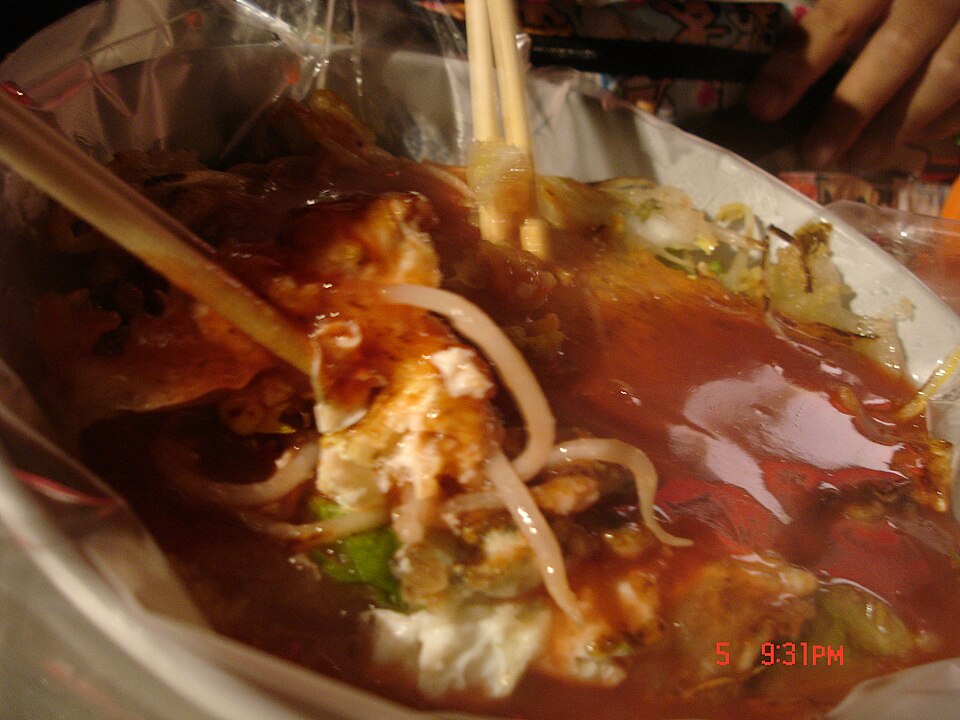
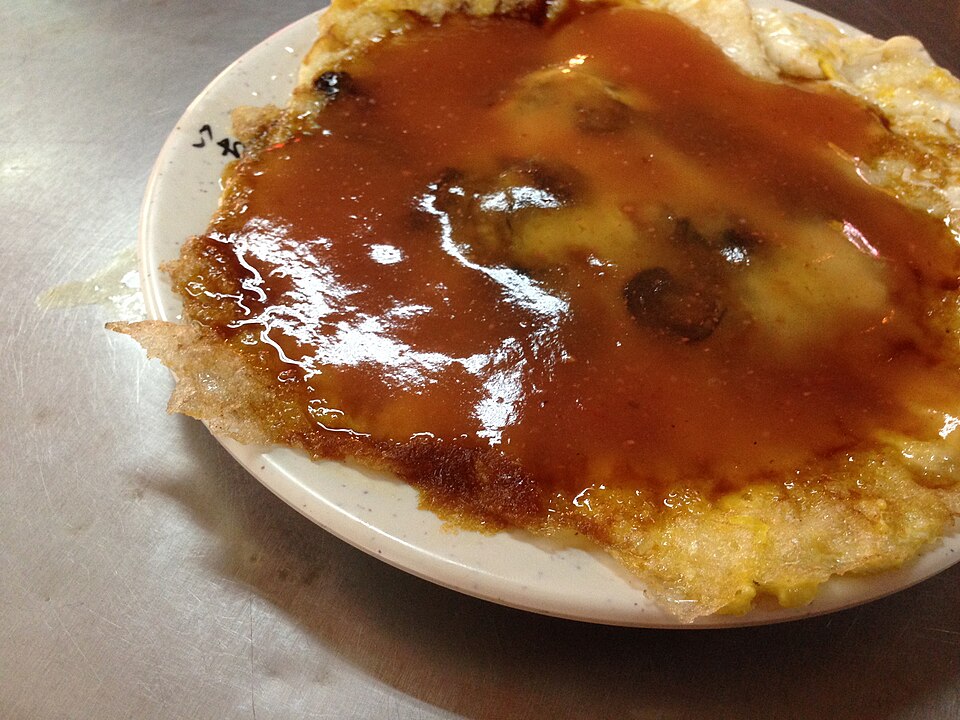
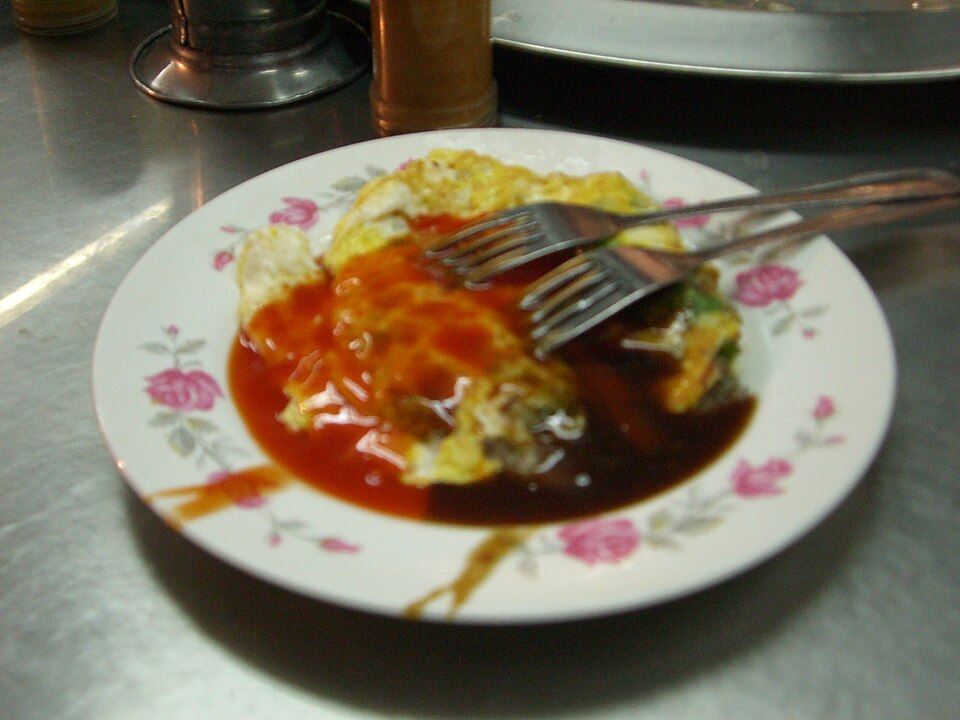
Oyster omelette (蚵仔煎) is a fried mix of small oysters, egg and greens, bound by a sweet potato starch batter that sets translucent and chewy rather than crisp. Taiwanese cooks usually add a sweet, hot red sauce made with ketchup, miso and chilli bean paste. Almost every night market in Taiwan has a stall selling it.
Where it came from
The dish comes from the Southern Min (Minnan) food tradition of the Hokkien and Teochew peoples of southern Fujian and the Chaoshan area, whose migrants later carried it to Taiwan and across South-east Asia. Two styles grew apart. Hokkien cooks, whose version Taiwan follows, use hen's eggs. Teochew cooks in Chaoshan and Hong Kong use duck eggs and fry it drier and crisper than the chewy, translucent Taiwanese kind.
A well-known Taiwanese story credits Koxinga (Zheng Chenggong, 鄭成功). In 1661, the tale goes, his army fighting the Dutch in Tainan ran short of food and improvised with local oysters and sweet potatoes. It is a legend, and the writer Yu Fu (魚夫) calls it nonsense. He cites Kayaba Saburō (萱場三郎), a technician in the Japanese colonial government, who concluded that settlers from Quanzhou brought oyster farming to Dongshi in Chiayi in 1719, which would have nothing to do with Koxinga's campaign.
The main island's four big oyster-farming areas are Wanggong (Changhua), Taixi (Yunlin), Dongshi (Chiayi) and Qigu (Tainan). The food writer Chen Ching-yi (陳靜宜) reports that a 2007 Global Views (遠見) survey of 1,000 people in Taiwan voted oyster omelette the snack most representative of Taiwanese food.
How it is made
Oysters, egg and greens are fried together, often in lard, and a thin sweet potato starch batter is poured over to bind them. Today's sweet potato starch is less sticky than it used to be, so many cooks mix in some potato starch (太白粉). The omelette is sauced before serving. Swap the oysters for shrimp and it becomes shrimp omelette (蝦仁煎); leave out the seafood and you have egg omelette (蛋煎), just egg, vegetables and batter. Squid versions (花枝煎) also exist.
How to eat it
Taiwan treats it as a street snack (小吃), eaten hot from night-market stalls. In parts of Fujian and Chaoshan it is a restaurant dish instead. If you do not eat oysters, ask for the shrimp version (蝦仁煎). Many stalls can also make it without seafood for people with allergies.
Around Taiwan
- Tainan
- Tainan cooks favour plump, fattened oysters and add minced pork sauce (肉燥) to calm the fishy taste. Traditional Tainan Feast in Anping serves it among its old Tainan classics, and winter melon tea goes well with it.
- North
- Northern cooks often add baby bok choy or crown daisy. A stall at Keelung's Miaokou night market fries over charcoal rather than gas, and a Fuzhou-style dish in Taipei puts the omelette inside a guangbing (光餅) bun.
- South
- In southern Taiwan, mung bean sprouts are the more common vegetable in the mix.
- Outlying islands
- Kinmen cooks use small stone oysters (石蚵), called pearl oysters locally: batter goes into the pan first, then an egg, then a big handful of oysters. In Penghu the dish is rare, since stone oysters there are mostly eaten raw with wasabi and farmed ones are grilled.