What it is
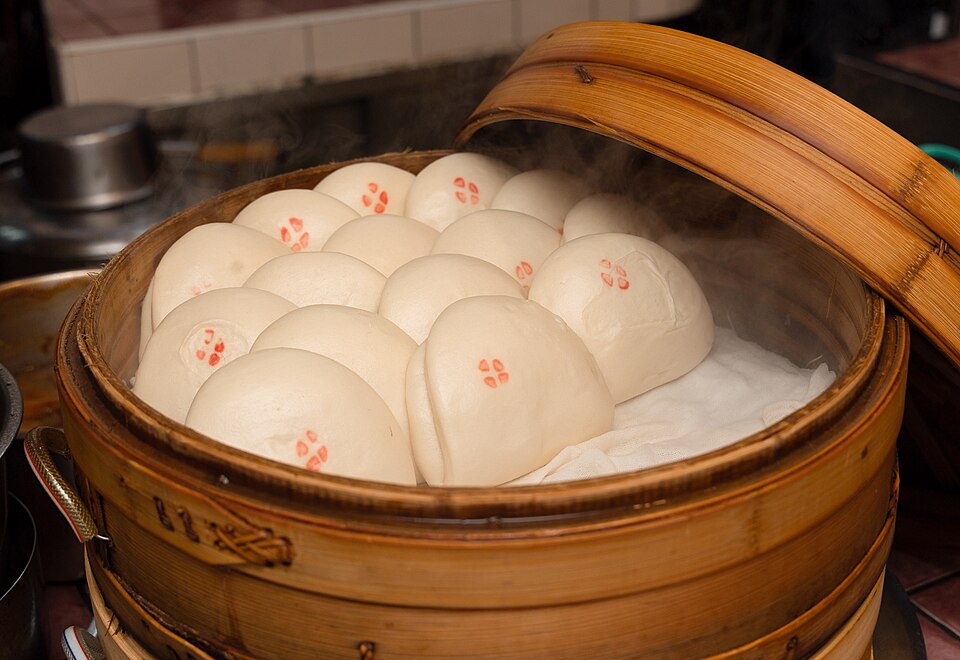
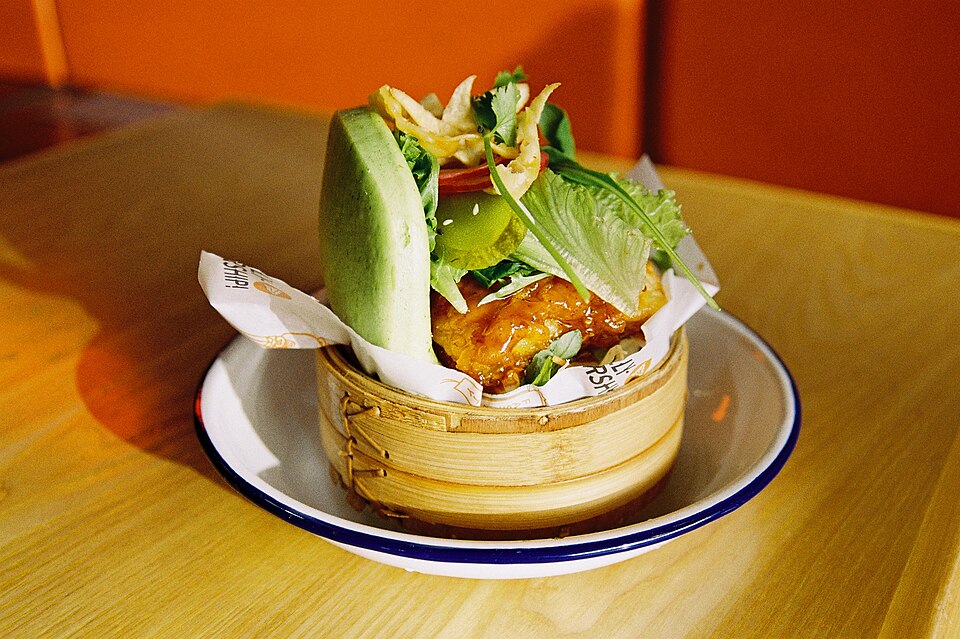
Gua bao (割包 or 刈包) is a flat, half-moon steamed bun, about 6 to 8 cm across, folded open and filled like a sandwich. The classic filling is soy-braised pork belly, stir-fried pickled mustard greens (酸菜), coriander and sugared ground peanuts. The sour greens cut through the fatty pork. In Taiwanese the name is said kuah-pau.
Where it came from
The bun comes from coastal Fujian, with both Quanzhou and Fuzhou named as its home. In Quanzhou it is called rou jia bao (肉夾包), and in Hui'an it marks a daughter's wedding. Fuzhou migrants are thought to have brought it to Taiwan. Under Japanese rule merchants ate it at ritual festivals. Pork was expensive and flour scarce at the time, so it only became an everyday street food in the 1970s.
The Taiwanese nickname hó͘-kā-ti (虎咬豬, 'tiger bites pig') pictures the bun as an open mouth clamped round a slab of pork. It sounds close to a phrase meaning 'bite hold of good fortune' (福咬住), and the bun's shape is likened to a full wallet. Both ideas tie it to weiya (尾牙), on the 16th day of the 12th lunar month. This is the year's last offering to the earth god, businesses treat their staff to a dinner, and many people eat gua bao.
Abroad, David Chang's Momofuku restaurants made pork belly buns popular in the West from around 2004, and Eddie Huang's BaoHaus, opened around 2009, spread the name gua bao.
How it is made
Pork belly is red-cooked, that is, braised slowly in soy sauce. Pickled mustard greens are chopped and stir-fried. The bun is a lotus-leaf bun (荷葉餅), a flat round of dough folded in half and steamed, so it opens like a pocket. It is filled to order with pork, greens, peanut sugar and coriander.
How to eat it
Eaten by hand as a snack, often at night markets, where four-herb soup (四神湯) is a common partner. Some shops let you choose fatty (肥), lean (瘦) or mixed (綜合) pork. Coriander is standard, so ask for it to be left out if needed (不要香菜).
Around Taiwan
- Tainan
- A Song Gua Bao (阿松割包), in Yongle Market on Guohua Street, has traded for about 80 years. Besides regular and lean buns it makes one with pig's tongue, and it uses peanut butter in place of the usual peanut powder.
- Kaohsiung
- Chun Lan Gua Bao (春蘭割包) in Sinsing District has made its name since 2000 with oversized, generously filled buns and a red chilli sauce. It also sells a vegetarian version and holds a Michelin Bib Gourmand.
- North
- In Taipei, Yuan Fang Gua Bao (源芳刈包) in Huaxi Street Night Market, Wanhua, dates from 1955. Lan Jia Gua Bao (藍家割包), in the Gongguan area of Zhongzheng District, offers five choices of pork, from all fat to all lean.