What it is
Taro balls (芋圓) are small, chewy pieces of dough made from steamed taro and sweet potato starch. The taro gives them a pale purple or grey colour. They are often sold with yellow sweet potato balls (地瓜圓), and both are used as toppings on tofu pudding, shaved ice and hot grass jelly.
Where it came from
Taro balls are tied to Ruifang (瑞芳), the hill district of New Taipei that takes in the old gold-mining town of Jiufen (九份). One account credits Tsai Lin Pao-yun (蔡林保雲), who married into a Ruifang family in 1938 and helped run its grocery. She first sold plums at the shop door, then set up a shaved-ice stall, where in 1946 she came up with the balls. Her grandson's shop, Bao Yun Taro Balls (保雲芋圓), carries her name, and many Jiufen makers are said to have learned from her.
Jiufen made the dish famous. A Gan Yi Taro Balls (阿柑姨芋圓) started as a stall selling shaved ice near Jiufen Elementary School. The MICHELIN Guide dates it to the 1960s; other accounts say the 1970s. Customers asked for taro balls as a topping, and as tourists arrived they became the town's signature snack. Grandma Lai's Taro Balls (賴阿婆芋圓) on Old Street dates from the same period. Taro balls are now sold in almost every part of Taiwan.
How it is made
Taro is steamed until soft and mashed. Sweet potato starch (地瓜粉) is worked in to make a dough, which is rolled into ropes and cut into short pieces. The pieces are boiled until they float. Sweet potato starch gives a springier bite, while potato or tapioca starch makes softer balls. Swapping the taro for sweet potato gives yellow sweet potato balls, and mung bean paste gives mung bean balls (綠豆圓). Some Jiufen shops, such as Grandma Lai's, still make theirs by hand every day.
How to eat it
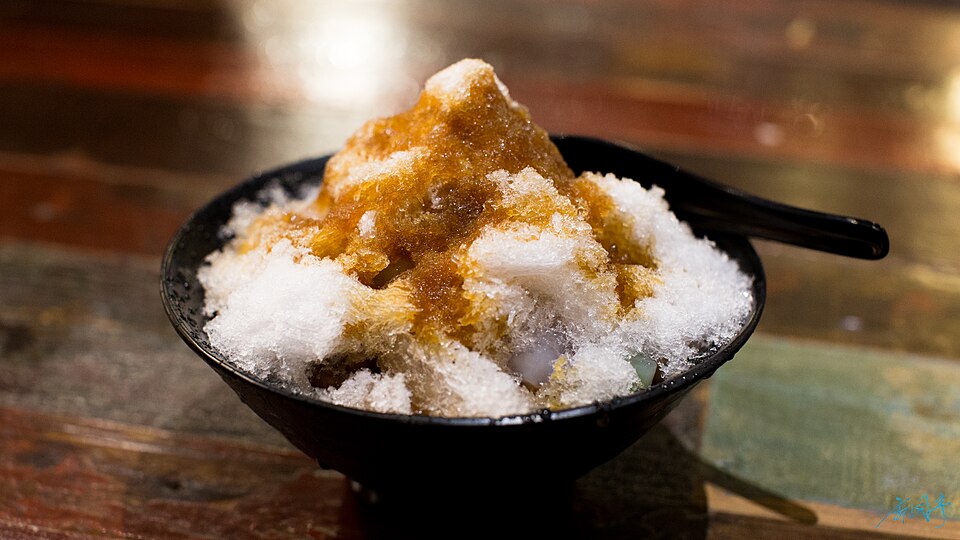
Taro balls come in a bowl of syrup, either hot or over shaved ice. Shops usually mix them with sweet potato balls and add beans such as red bean. In Jiufen the broth is often brown sugar, and you choose hot (熱的) or iced (冰的) when ordering.
Around Taiwan
- North
- Jiufen and the rest of Ruifang are the home ground, and taro-ball shops line Jiufen Old Street. A Gan Yi, at the top of the street, has a dining room on the slope with views over the valley to the sea.
- Central
- Dajia (大甲) in Taichung is Taiwan's best-known taro-growing area. The Da'an River supplies water, the soil holds moisture yet drains well, and big day-night temperature swings slow the crop, which takes eight to ten months. Grandma Lai's in Jiufen uses Dajia taro.