What it is
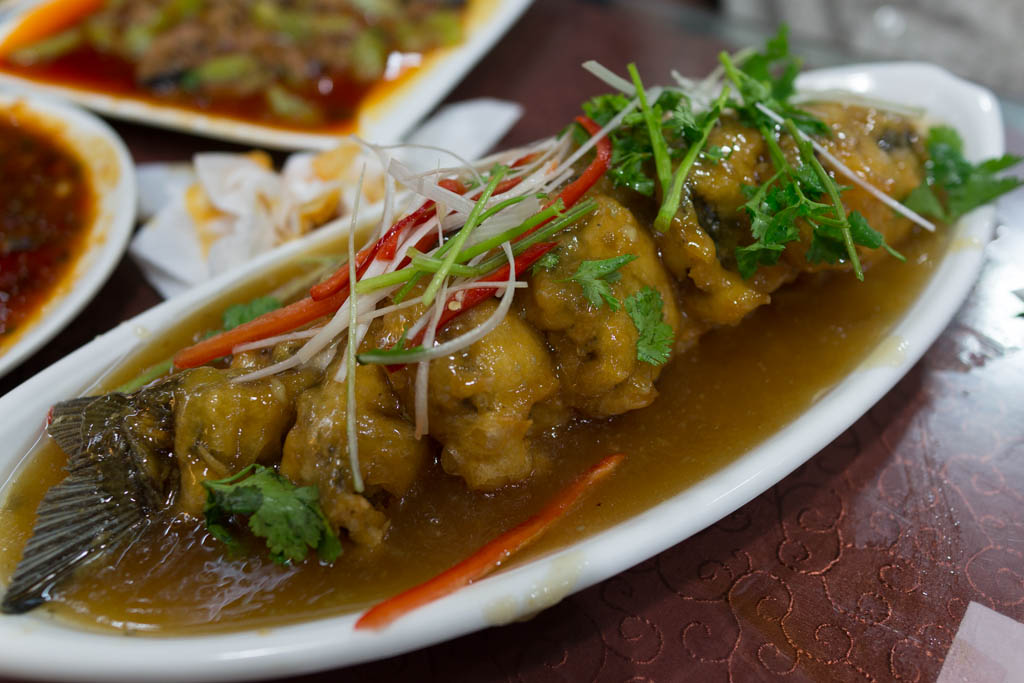
Five-willow fish (五柳枝, also written 五柳居) is a fish dish from old Taiwanese banquet and restaurant cooking. The fish is fried crisp, then covered with a thickened sweet and sour sauce full of shredded vegetables such as carrot, wood ear fungus, onion, bamboo shoot and spring onion. In Tainan it is often made with milkfish.
Where it came from
Where the dish came from is disputed, and so is its name. One account traces it to Fuzhou. The columnist Chan Chiao (詹翹), writing in Storm Media, suggests 五柳枝 is a sound shift from 五柳居. He traces that name to an eatery known for fish soup and links it to Song Wusao (宋五嫂), a cook who moved to Hangzhou in the Southern Song. He sees today's saucy version as a descendant of vinegar fish (醋溜魚), and calls a television story crediting the poet Du Fu with the dish a pretty mistake.
The name was known in Taiwan by 1931, when a note by Wang Kai-yun (王開運) in the Sanliujiu Xiaobao (三六九小報) said 五柳居 had once been the rage in Taiwanese cooking. The Taiwanese-Japanese dictionary of the same years describes it as fish steamed with matsutake, pork and spring onion, quite unlike the fried version served now.
The dish may have begun with ritual offerings, which called for a whole fish. A milkfish was fried for the altar, then turned into 五柳枝 afterwards. Wu Huo-tu (吳火塗), the veteran banquet chef at Hsin Hsin (欣欣餐廳) in Tainan, says the five colours stand for five generations living together at New Year.
How it is made
The fish, often whatever the market has that day, is cut into pieces and deep-fried until crisp outside and soft inside. The vegetables are cut into fine shreds and cooked in a sauce of sugar and vinegar thickened with starch. Old-style cooks use no ketchup. Some versions add day lily buds, sour bamboo shoot and shiitake, or chilli, garlic and ginger. The sauce goes over the fish just before serving.
How to eat it
It is a fish course at banquets (辦桌) all year round and a popular New Year dish. Old Taiwanese restaurants in Tainan keep it on the menu. Order it to share, with rice. Look for 五柳居 as well as 五柳枝 on menus.
Around Taiwan
- Tainan
- Hsin Hsin (欣欣餐廳) lists it as 五柳居, a dish also found at A-Hsia (阿霞飯店) and A-Mei (阿美飯店). The historian Hsieh Shih-yuan (謝仕淵) thinks its original form may survive only at Hsin Hsin.